We often see property owners torn between quick fixes and permanent safety when a circuit trips.
The dividing line separating basic diy electrical work vs licensed electrician intervention determines your long-term property safety.
Our daily inspections reveal how easily a simple mistake escalates into a costly repair.
This guide breaks down the legal guidelines, the actual data behind common failures, and practical steps to protect your home.
What the law in Malaysia actually allows
We constantly receive questions regarding whether is diy wiring legal in malaysia, and the answer lies in Regulation 11(1) of the Electricity Regulations 1994. This legal standard requires written approval and a competent person for any fixed electrical wiring because Jabatan Bomba dan Penyelamat Malaysia reports that roughly 60% of house fires originate from electrical faults. Our technicians frequently correct illegal modifications that pose a severe risk of fatal shocks.
A few specific tasks carry minimal risk and remain perfectly legal for a homeowner to tackle. We encourage residents to handle simple maintenance independently to save time and money. These safe, everyday tasks include:
- Changing a standard light bulb.
- Swapping a decorative lamp shade.
- Resetting a tripped breaker at the main board.
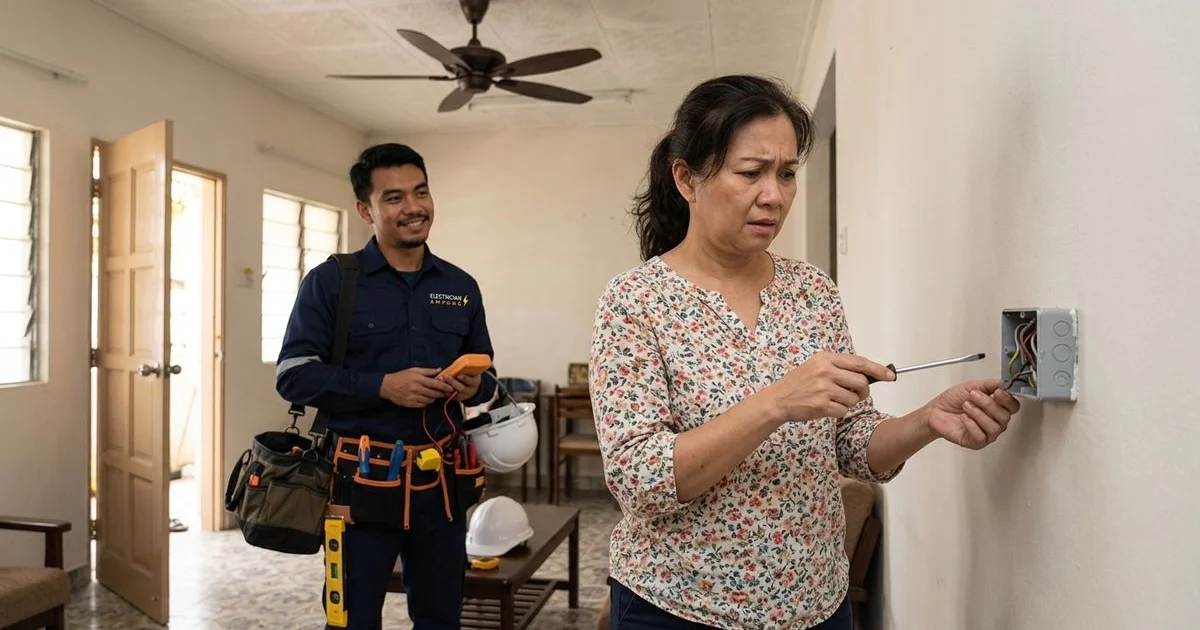
Our concern grows the moment a project requires opening a wall socket or modifying circuit cabling. Working inside the distribution board requires the verified expertise of a registered wireman.
We advise treating any uncertain project as a strict professional requirement. Asking a question costs nothing, whereas fixing a burnt distribution board runs into thousands of Ringgit.
Where DIY electrical work goes wrong
We trace the majority of diy electrical work risks back to a few specific, critical errors. A loose termination ranks as the most frequent culprit behind domestic power failures. Our thermal cameras often show these loose connections heating up rapidly every time current flows. This continuous heating scorches the terminal over several months and easily ignites surrounding materials.
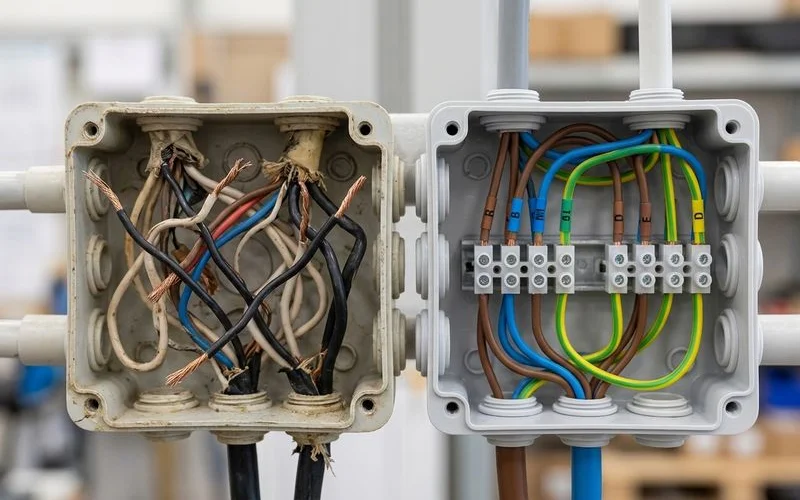
We also constantly find undersized cables connected to high-load appliances. Suruhanjaya Tenaga guidelines clearly mandate a minimum 4.0mm² cable and a 20A double-pole switch for a standard 3.6kW Malaysian water heater. Our crews frequently discover homeowners using thin 1.5mm² or 2.5mm² lighting cables for these heavy loads. This inadequate sizing causes the PVC insulation to melt because the wire cannot carry the current safely.
We see poor earthing as the third major hazard in self-taught repairs. The earth wire provides a vital safety path that directs a fault into the ground rather than through a human body. Our safety tests prove that skipping this connection turns a simple metal appliance into a lethal hazard.
The danger is hidden
Bad DIY wiring often works fine at first. The fault sits quiet behind the wall until heat, moisture or load finally pushes it over the edge.
Emergency technicians handle these exact complications on site every single week. Many of these invisible threats overlap directly with the common electrical hazards found throughout Malaysian residential properties. We consistently warn clients that a visually neat job does not guarantee internal safety.
Liability and insurance after unlicensed work
We must address the severe financial liabilities attached to illegal electrical modifications. Persatuan Insurans Am Malaysia (PIAM) regulates standard fire policies across the country. Our experience shows that property insurers will categorically reject a claim if an unlicensed modification caused the fire. The policy strictly requires all electrical installations to follow the Electricity Supply Act 1990.
Our teams frequently see adjusters deny claims based on these three specific violations:
- Modifying a distribution board without an ST-registered contractor.
- Installing high-draw appliances on under-rated circuits.
- Failing to install mandatory Residual Current Devices (RCD).
Financial risk extends far beyond your own property lines. A fire spreading to a neighbouring terrace unit leaves the original property owner completely liable for the adjacent damage.
Our licensed installation services supply an official receipt and ST-certified documentation. This clear paper trail serves as your primary defence if an insurance adjuster ever questions the integrity of your wiring.
DIY vs licensed electrician at a glance
We prepared this clear comparison to highlight the precise differences in the diy electrical work vs licensed electrician debate. Reviewing this data makes the safest choice obvious for any property owner.
| Factor | DIY Risk Profile | Licensed Electrician Standard |
|---|---|---|
| Legal for fixed wiring | Illegal under Regulation 11(1) | Fully compliant with ST regulations |
| Correct cable sizing | Frequently undersized (e.g., 2.5mm² for heaters) | Precisely calculated (e.g., 4.0mm² minimum) |
| Earthing and shock protection | Often bypassed or untested | Verified with specialized loop impedance testers |
| Insurance cover if a fault occurs | Voids PIAM standard fire policies | Fully protected by certified documentation |
| Workmanship guarantee | Zero protection | 7-day minimum service guarantee |
Our team notices a very consistent pattern in these scenarios. Attempting the work yourself saves a small amount of money today but introduces massive, unquantifiable risks tomorrow. We strongly advocate for paying the professional rate upfront to permanently eliminate the danger of an electrical fire. The upfront cost guarantees long-term peace of mind.
What genuinely needs a licensed wireman
We classify certain high-risk installations as absolute mandatory zones when considering when to hire a licensed wireman. These critical tasks go far beyond basic household maintenance:
- Pulling new circuits or conducting a full property rewiring.
- Upgrading or replacing a main distribution board (DB box).
- Wiring high-draw appliances like a 3.6kW water heater.
- Installing heavy, ceiling-mounted fan fixtures.
Our crews refuse to compromise on safety because these jobs involve live municipal supply lines. Every single project requires precise earthing configuration to prevent fatal shocks.
Professional Accountability
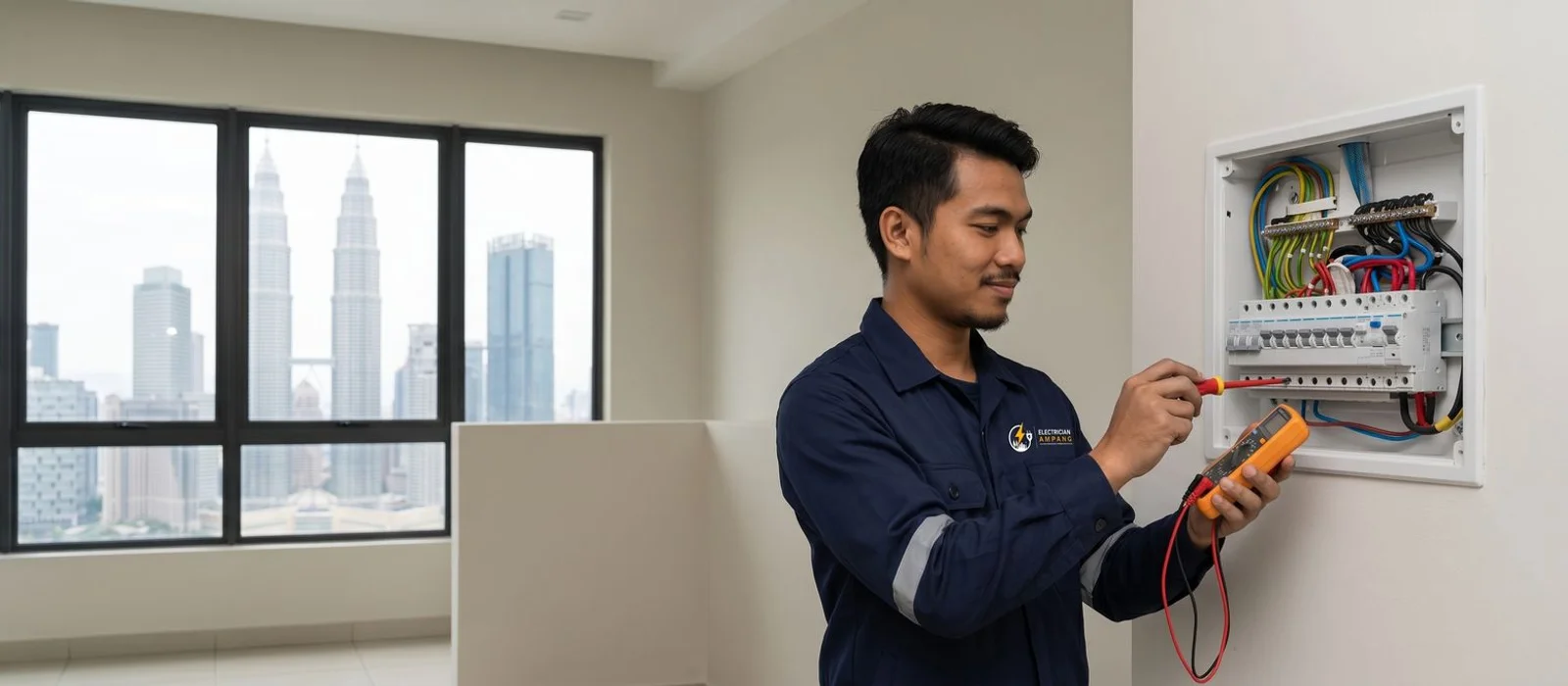
Our lead electrician Keat brings over 15 years of rigorous field experience to every job. Electrician Ampang operates under a strict owner-managed model to guarantee complete safety.
A responsible property owner should get a licensed electrician to evaluate any situation that crosses the line into dangerous territory, settling the diy electrical work vs licensed electrician question permanently.
Our policy fully waives the flat RM50 on-site checking fee the moment you accept the final service quotation.
This straightforward approach guarantees you receive a safe, technically accurate diagnosis without relying on dangerous guesswork.