
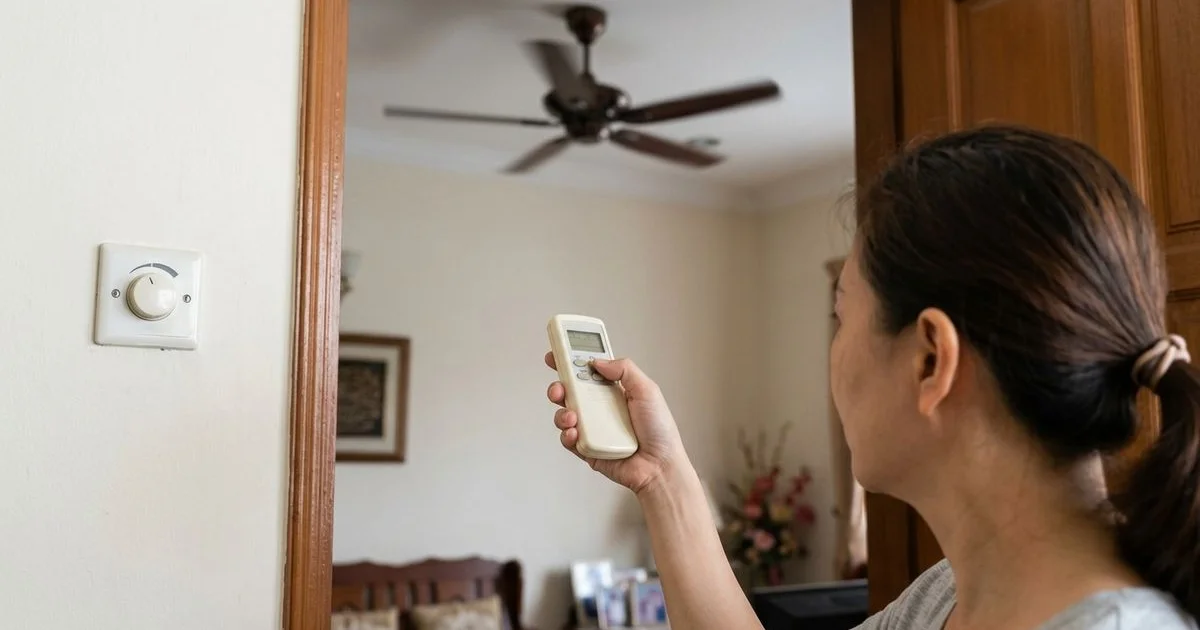
Our electricians see dozens of burnt-out fan controls every month across the Klang Valley.
Evaluating a ceiling fan regulator vs remote heavily impacts your home’s wiring requirements.
This simple hardware decision determines how easily you can upgrade your fixtures later.
We will break down the true costs, the wiring realities, and the best retrofit options for your space.
Two ways to control fan speed
Every ceiling fan needs a reliable method to set its rotation speed, making ceiling fan speed control options a top priority for homeowners.
Malaysian homes typically rely on two distinct control methods that operate in completely different ways.
Our installation teams often find that property owners misunderstand the hardware hiding behind these common switches.
The Traditional Wall Regulator
A wall regulator is a physical controller permanently fitted into the wall, usually mounted right next to your light switches.
You turn a dial or press a switch to change the airflow speed.
We frequently recommend classic 5-speed electronic dial models like the KDK K15V0 because their basic 240V/50Hz design is highly reliable.
The control stays in one fixed place, making it impossible to misplace.
A standard unit handles daily wear very well over many years.
The Modern Remote Receiver
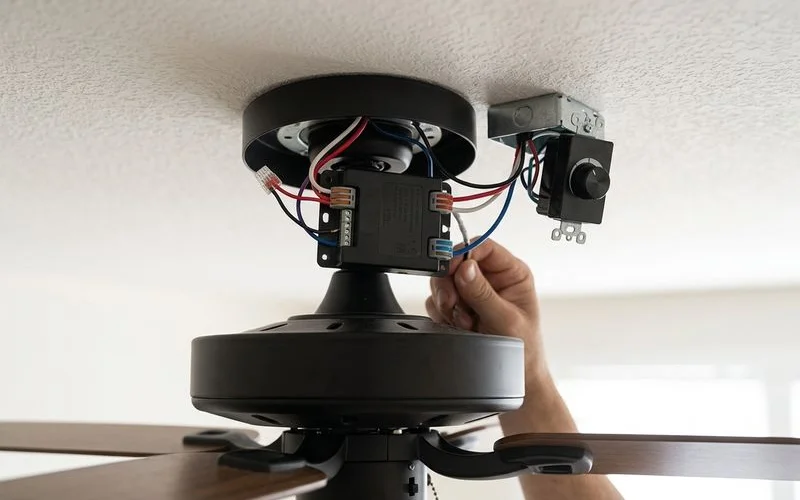
Our technicians install remote controls using a small radio frequency receiver.
This receiver unit tucks neatly inside the fan canopy, which is the cover at the top of the motor.
It picks up the signal from a handheld remote to adjust the speed or activate sleep timers.
We love how the controller travels with you around the room.
This mobility offers immediate comfort adjustments from the sofa or bed.
The convenience factor is the main reason homeowners upgrade their older units.
Wiring differences between the two
Our experience shows that wiring is where these two options really differ.
A wall regulator is wired into the wall point, sitting on the electrical run between the switch and the fan.
Fitting one is simple if your home already has a regulator point ready to go.
We must run new 1.5mm SIRIM-approved PVC cable to a wall position if the point does not exist.
This process involves hacking the wall or laying exposed PVC casing.
A remote setup is the exact opposite and requires much less structural work.
Our crews wire the receiver directly at the fan itself, securing it inside the ceiling canopy.
There is no need to run a new cable down the wall to a switch height.
This makes a remote extremely handy for rooms where adding a wall control would mean tearing open finished plaster.
Wiring access is the deciding factor
Our electricians always check the existing wall points first before making a recommendation.
A regulator is easy to install if your room already has the required wiring.
A remote often saves the expense and mess of new wall regulator wiring if that point is missing.
Convenience and retrofit notes
We see convenience as the obvious draw of a modern remote setup.
You can change the fan speed from the bed or the sofa without getting up.
Many remote fans also handle the integrated LED light from the exact same handset.
Our 2026 repair logs show that the trade-off involves managing specific electronic maintenance factors:
- AAA batteries run flat, and the handheld unit easily slips between sofa cushions.
- Universal receiver kits make it easy to add remote to ceiling fan models you already own.
- We source standard replacement wall regulators for as little as RM15, making wired points incredibly cheap to maintain over time.
- A physical wall regulator never goes missing and provides uninterrupted daily use.
Keeping the wall regulator is the simplest route for a brand new fan in a room that already has a wired point.
We strongly advise against adding extra electronic components when a reliable wired point already exists.
The simpler the system, the longer it will last without sudden failures.
A basic setup always saves money in the long run.
Ceiling fan regulator vs remote at a glance
We have summarized the main differences below to help you compare these options quickly.
This table breaks down the key factors ranging from wiring requirements to long-term maintenance.
Review these points carefully before purchasing your next ceiling fixture.
| Factor | Wall Regulator | Remote Control |
|---|---|---|
| Control location | Fixed on the wall | Anywhere in the room |
| Wiring requirements | 1.5mm cable at the wall point | Receiver wired at the fan canopy |
| Easy retrofit | Only if a wall point exists | Yes, using a universal RF receiver |
| Parts to maintain | None | AAA batteries and handset |
| Reliability | Very stable, low replacement cost (RM15+) | Good, depends on receiver heat exposure |
Which one suits you
We find that a regulator is hard to beat for a steady, no-fuss setup.
It is highly reliable and there is absolutely nothing extra to lose or replace.
A remote remains a strong choice for pure comfort, especially in a bedroom or a room lacking a regulator point.
We always ensure the electrical wiring is done properly either way so the fan runs safely on its circuit.
Proper installation matters, which is why the ceiling fan installation service covers both regulator and remote setups.
If you are still weighing a ceiling fan regulator vs remote, ask about speed control options to get clear guidance for your specific home. And if the fan itself is not chosen yet, our guide on what size ceiling fan you need covers blade span and room fit.