
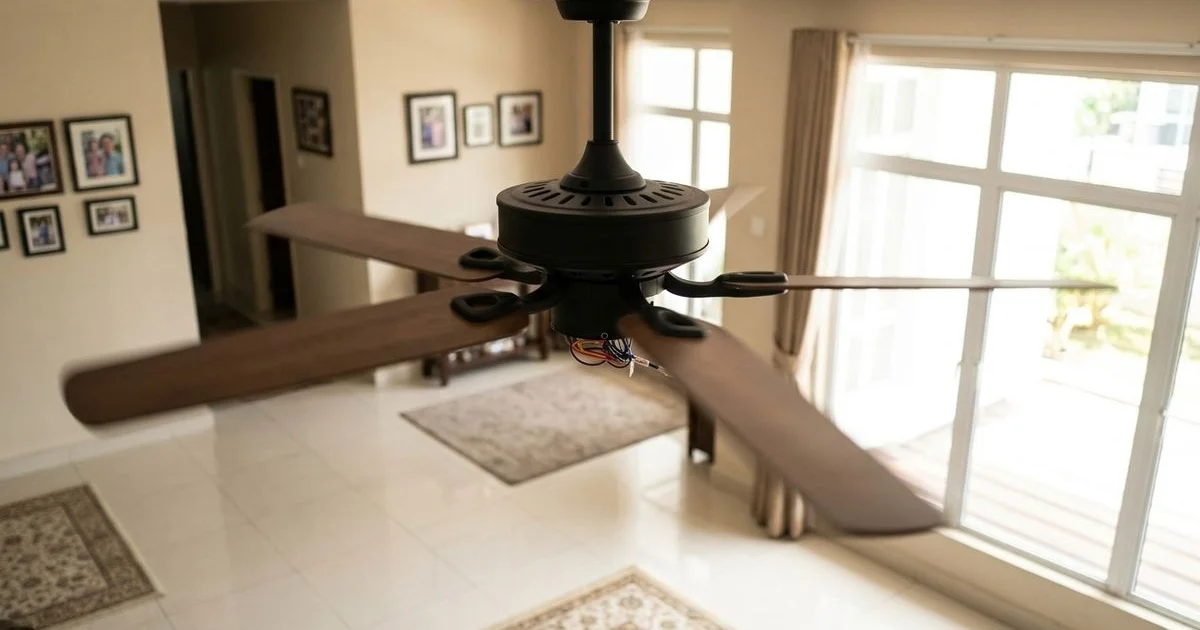
Selecting the right fixture is crucial when you realise a poorly sized unit either does nothing but spin noisily or turns your space into an uncomfortable wind tunnel.
We see this exact issue frequently when homeowners ask us what size ceiling fan do i need, a question Electrician Ampang has answered daily since starting our services in 2011. Finding the perfect fit comes down to matching the precise blade span to the square footage of your room.
Our team will break down the sizing metrics, explain height safety rules, and share practical tips to maximise airflow.
Match blade span to your room
The most critical number on any ceiling fixture is its blade span.
Our technicians define this as the full width measured from the tip of one blade straight across to the tip of the opposite blade. Getting this dimension right ensures that air moves evenly across the entire space.
We often encounter standard master bedrooms in Malaysia averaging around 224 square feet, or 14 by 16 feet. Upgrading to a 52-inch or 56-inch span is highly recommended for rooms of this size.
Our sizing table provides a simple ceiling fan blade span guide to pair the correct measurement with standard home layouts.
| Room Type | Average Size | Recommended Blade Span |
|---|---|---|
| Small bedroom or study | Under 100 sq ft | 36 to 42 inches |
| Standard bedroom or dining area | 100 to 150 sq ft | 44 to 52 inches |
| Large living room or open hall | Over 200 sq ft | 56 to 60 inches |
A unit that is too small for the area will spin rapidly but barely circulate air where you sit. We always warn clients that installing a massive 60-inch model in a compact space creates excessive noise and a harsh breeze.
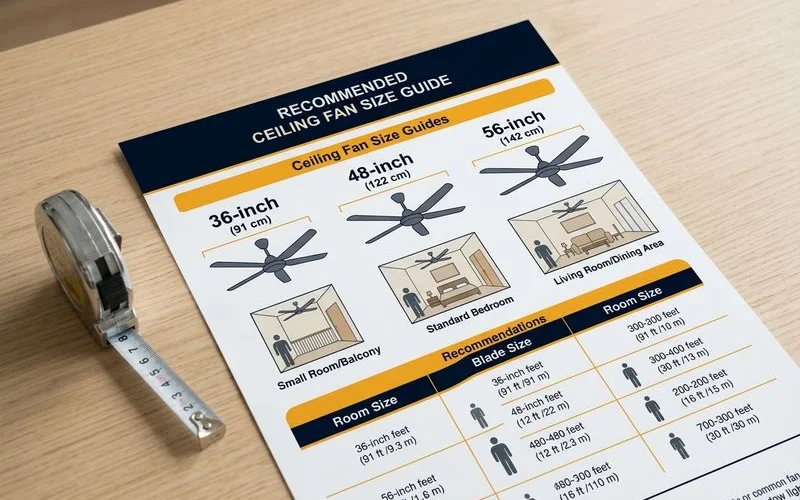
Proper sizing guarantees a steady, comfortable airflow throughout the day.
Our goal is to balance the visual scale of the fixture with its actual cooling performance.
Ceiling height and the downrod
Room width represents only half the story when evaluating cooling requirements.
We always assess ceiling height to determine exactly how the fixture should hang. National safety guidelines from Suruhanjaya Tenaga require blades to sit a minimum of 2.3 metres above the finished floor.
Our installers use a sturdy downrod to lower the fixture to a functional level in landed properties with high ceilings exceeding 3 metres. Skipping this metal extension pipe means a high-mounted unit pushes most of its air into the empty space above your head.
Mind the gap underneath
Aim to keep the blades well clear of the tallest person in the house. Comfort and safety both depend on that gap.
We install hugger models, sometimes called flush-mount fans, for typical condominiums where ceilings often sit at a lower 2.6 metres.
This specific design sits tight against the ceiling so there is safe headroom below. Understanding the relationship between downrod and ceiling height ensures long-term comfort. Our team frequently corrects common sizing mistakes related to picking the wrong mount style.
Airflow, room use and when you need two
Bigger fans move a larger volume of air, but the motor speed settings matter heavily.
We strongly advocate for modern DC motor units in bedrooms because they provide a low, whisper-quiet setting. Active spaces like a living room or a hot kitchen usually need more push to maintain comfort.
Our experience shows that a model with stronger, higher speed options suits those demanding environments much better.
Room shape dictates airflow efficiency just as much as total square footage. Our technicians look for these specific layout challenges:
- Long, narrow spaces where one fixture struggles to reach both ends.
- Large open-plan halls that suffer from stagnant air pockets.
- L-shaped rooms requiring separated cooling zones.
Placing two correctly sized units about 3 metres apart gives far more even airflow than relying on a single oversized one. We apply this exact dual-fan approach to solve ventilation issues in extensive living areas. Taking a quick look at the structural layout often settles any lingering doubts.
Our professional electricians can advise on the ideal dimensions on site if you prefer an expert eye before you buy. Finding the perfect balance of form and function prevents costly electrical reworks later. Our ceiling fan installation service handles the wiring, the secure mounting, and the final safety testing once you select a unit.
Picking the correct ceiling fan size for room dimensions is only the first step, while securing it properly is the next critical phase. A comprehensive guide on ceiling fan mounting and support explains exactly how the fixture is held up safely.